Dam Gate Rubber Seals
Reliable Rubber Sealing Solutions for Dams, Barrages & Hydraulic Gates
Indian Rubber Industry manufactures and supplies high-performance Dam Gate Rubber Seals designed to provide reliable water-tight sealing in hydraulic structures.
Our rubber seals are engineered to accommodate gate movement, water pressure and operating conditions while helping minimize leakage and maintain the efficient operation of hydraulic gates.
What is a Dam Gate Rubber Seal?
A Dam Gate Rubber Seal is an engineered rubber sealing component installed between a hydraulic gate and its sealing surface or frame to prevent unwanted water flow when the gate is closed.
Hydraulic gates are used in dams, barrages, irrigation structures, spillways, canals and hydropower facilities to regulate and control water. Rubber seals create a flexible sealing interface that can accommodate movement and pressure while maintaining contact between the gate and its sealing surface.
Rubber is particularly suitable for these applications because of its elasticity, flexibility and ability to recover after deformation. Different seal profiles are selected according to the gate design, water head, movement, mounting arrangement and sealing location.
Why are Dam Gate Seals Important?
A properly designed gate seal helps:
- Reduce water leakage
- Maintain effective gate operation
- Accommodate gate movement and deflection
- Protect sealing surfaces
- Improve the service life of hydraulic gate systems
- Reduce maintenance requirements
- Maintain reliable water-flow control
Why choose indian rubber industry?
Engineered Rubber Seals for Critical Water-Control Applications
At Indian Rubber Industry, we understand that dam gate seals are not simply standard rubber profiles. Their performance depends on the correct combination of profile geometry, rubber compound, hardness, dimensions, installation and operating conditions.
Our focus is on providing rubber sealing solutions designed and manufactured around the customer’s application.
Our Strengths
Application-focused manufacturing
Solutions developed around gate configuration and sealing requirements.
Custom Profiles
Profiles can be manufactured according to approved drawings, samples or specified dimensions.
Quality-focused Production
Attention to dimensional accuracy, surface finish and material consistency.
Multiple Rubber Options
Material selection can be matched to environmental and operating requirements.
Industrial Experience
Serving infrastructure, construction and industrial applications with engineered rubber products.
Made in India
Prevents cracking, concrete damage, and stress concentration.
Applications Of Dam Gate Rubber Seals
Where Are Dam Gate Rubber Seals Used?
Dam gate rubber seals are used across a wide range of water-control and hydraulic infrastructure applications.
Key Applications of Dam Gate Rubber
Dams
For sealing hydraulic gates used to regulate stored water and discharge.
Barrages
Used around gates controlling water levels and flow.
Hydropower Plants
For hydraulic gates associated with water intake, discharge and flow-control systems.
Irrigation Projects
Used in gates and water-control structures serving irrigation networks.
Canal Gates
Designed to help control water flow through irrigation and drainage canals.
Spillways
Used in gate assemblies exposed to significant water pressure and flow.
Sluice Gates
For reliable sealing around water-control gates.
Penstock & Hydraulic Structures
Used where controlled water flow and reliable sealing are required.
Industry sources similarly identify radial, stop-log, spillway, sluice, vertical-lift and other hydraulic gate configurations as applications for rubber gate seals.
Types Of Dam Gate Rubber Seals
Dam Gate Rubber Seal Profiles
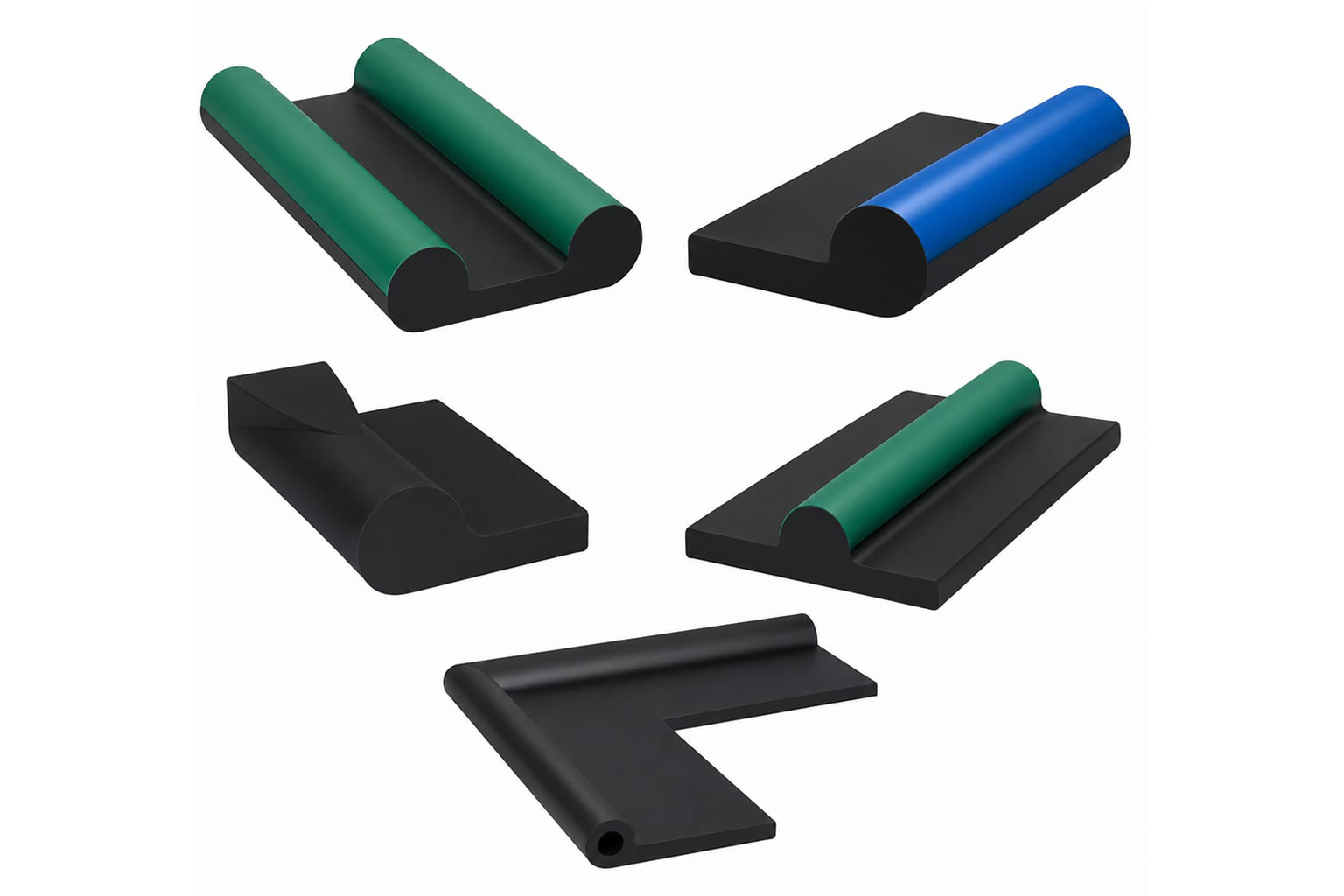
Different hydraulic gate designs require different sealing geometries. Indian Rubber Industry can offer profile-based and application-specific sealing solutions.
Z-Type Rubber Seal
Designed for applications where the seal profile needs to accommodate gate movement while maintaining effective contact with the sealing surface.
P-Type / Music Note Seal
A bulb-style profile designed to provide flexible contact and compression against the sealing surface.
L-Type Rubber Seal
Used in applications where an L-shaped mounting and sealing configuration is required.
J-Type Rubber Seal
A J-shaped profile suitable for specific hydraulic gate configurations and sealing arrangements.
Flat Rubber Seal
Used where a relatively simple flat sealing interface is appropriate.
Bulb-Type Rubber Seal
Features a bulb-shaped sealing section that compresses against the mating surface.
Double Bulb Seal
Provides two sealing bulbs within a single profile for applications requiring multiple contact points.
Double Stem Seal
Used for specific high-head or demanding hydraulic gate applications.
Cladded Rubber Seals
Rubber seals may also be supplied with suitable PTFE/Teflon, brass or stainless-steel cladding, where specified by the application.
Important: The final profile should be selected based on the gate design, sealing position, water head, movement and manufacturer’s/project specifications rather than simply selecting a profile by name.
Sealing Locations
Dam Gate Seals for Different Gate Positions
Dam gate seals may be designed for installation at different locations on the gate assembly.
Side Seals
Installed along the sides of the gate to control leakage between the gate and side frames.
Bottom Seals
Used along the bottom edge of the gate where sealing against the sill or bottom surface is required.
Top Seals
Used along the upper section of the gate.
Corner Seals
Designed to provide continuity at transitions between sealing surfaces.
Combined / Custom Sealing Systems
For complex gate configurations, custom profiles and corner arrangements can be developed according to engineering drawings.
Material Options Of Rubber Dam Gate Seals
Rubber Compounds for Dam Gate Seals
The rubber compound is an important factor in determining the performance and service life of a dam gate seal.
Depending on application requirements, suitable compounds may include:
Natural Rubber (NR)
Known for its excellent elasticity, resilience and mechanical strength.
EPDM
Suitable for applications requiring strong resistance to weathering, ozone and water-related environmental exposure.
Neoprene
Can be considered where resistance to weathering and specific environmental conditions is required.
Special / Engineered Compounds
Custom compounds can be considered based on operating temperature, water conditions, mechanical requirements and project specifications.
Material selection should be finalized based on the actual operating environment and required specifications.
Technical Specifications
Dam Gate Rubber Seal Specifications
| Parameter | Typical / Custom Specification |
|---|---|
| Product | Dam Gate Rubber Seal |
| Seal Type | Z, P, J, L, Bulb, Flat, Double Bulb, etc. |
| Material | NR / EPDM / Neoprene / specified compound |
| Hardness | Application dependent |
| Profile | As per drawing / sample / requirement |
| Dimensions | Custom manufactured |
| Length | As required |
| Colour | Generally Black |
| Reinforcement | As specified |
| Cladding | PTFE / Brass / SS where required |
| Manufacturing | Extruded / Moulded |
| Application | Dams, Barrages, Spillways, Sluice Gates, Canals, Hydropower |
| Installation | Mechanical fixing / clamping arrangement as designed |
Manufacturing Process
How Dam Gate Rubber Seals Are Manufactured
Requirement Analysis
We understand the customer's application, gate type, sealing location, dimensions and operating conditions.
Profile & Drawing Review
The required cross-sectional profile is reviewed based on engineering drawings, samples or dimensional specifications.
Rubber Compound Selection
The appropriate rubber compound and hardness are selected according to the application.
Mixing & Compounding
Rubber and required additives are compounded to achieve the desired physical and performance characteristics.
Extrusion / Moulding
Depending on the profile, the seal is manufactured through extrusion or moulding.
Vulcanization
The rubber is cured to develop the required mechanical and elastic properties.
Inspection
The finished product is inspected for dimensions, profile accuracy, surface quality and specified physical properties.
Packing & Dispatch
Finished seals are packed appropriately and prepared for project delivery.
Extrusion and moulding followed by vulcanization are commonly used manufacturing routes for dam gate rubber seals.
Quality & Performance
Built for Demanding Hydraulic Environments
Dam gate seals operate in environments where water pressure, repeated gate movement, compression, abrasion, weather exposure and installation conditions can influence service life.
Our focus is therefore on:
- Consistent rubber compounding
- Accurate profile dimensions
- Good elasticity and recovery
- Resistance to water exposure
- Appropriate hardness
- Dimensional stability
- Reliable sealing contact
- Application-specific engineering
Designed for Reliable Sealing
The right seal profile and compound can help maintain effective contact with the mating surface while accommodating the movement required during gate operation.
Custom Manufacturing
Custom Dam Gate Rubber Seals
Not every hydraulic gate uses a standard profile.
Indian Rubber Industry can manufacture custom dam gate rubber seals based on:
- Engineering drawings
- CAD drawings
- Existing rubber samples
- Cross-sectional dimensions
- Gate drawings
- Project specifications
- Required length
- Required hardness
- Material specifications
- Cladding requirements
Send Us Your Drawing or Sample
Have an existing seal that needs replacement?
Share your:
Drawing + dimensions + application details
and our team can evaluate the requirement and recommend a suitable manufacturing solution.
Email us on : info@indianrubberindustry.com or call us on +919966633307
Replacement Seals
Dam Gate Rubber Seal Replacement
Over time, hydraulic gate seals may experience wear, deformation, cracking, hardening or loss of sealing efficiency.
Replacing worn seals can help restore the intended sealing performance of the gate system.
We Can Help With:
- Replacement rubber seals
- Existing-profile reproduction
- Custom seal profiles
- Project-specific dimensions
- Replacement based on samples
- Replacement based on drawings
Before Ordering a Replacement Seal
Ideally provide:
- Existing seal profile
- Seal dimensions
- Gate type
- Sealing location
- Operating water head
- Existing rubber specification, if available
- Required quantity
- Drawing or photograph
Maintenance
Dam Gate Rubber Seal Maintenance
Regular inspection can help identify sealing problems before they become major
operational issues.
Inspect For:
- Cracks
- Cuts
- Excessive wear
- Permanent deformation
- Hardening
- Surface deterioration
- Loose or damaged fixing arrangements
- Uneven compression
- Excessive leakage
Maintenance Tips
Inspect regularly
Check seals during scheduled gate maintenance.
Keep sealing surfaces clean
Remove debris and deposits that may interfere with sealing.
Check fixing arrangements
Loose clamps or fasteners can affect seal performance.
Avoid unnecessary mechanical damage
Care should be taken during gate movement and maintenance work.
Replace damaged seals promptly
A deteriorated seal may increase leakage and affect gate operation.
Why rubber for dam gate seals?
Why is Rubber Used for Hydraulic Gate Sealing?
Rubber is widely used for hydraulic sealing applications because it combines:
Flexibility
Allows the seal to deform against the mating surface.
Elastic Recovery
Helps the seal return toward its original shape after compression.
Water Resistance
Suitable rubber compounds can withstand prolonged exposure to water.
Shock & Movement Accommodation
Flexible sealing profiles can accommodate controlled movement and variations in contact.
Customizability
Rubber can be manufactured into complex profiles through extrusion and moulding.
Industries We Serve
Rubber Sealing Solutions for Infrastructure & Industry
Indian Rubber Industry serves applications across:
- Water Infrastructure
- Irrigation
- Dams & Barrages
- Hydropower
- Construction
- Civil Infrastructure
- Engineering
- Industrial Manufacturing
- Water Treatment
- Hydraulic Systems
Frequently Asked Questions — Dam Gate Rubber Seals
What is a Dam Gate Rubber Seal?
A Dam Gate Rubber Seal is an engineered rubber component installed between a hydraulic gate and its corresponding sealing surface or frame to minimize unwanted water leakage when the gate is closed. Rubber is commonly used because it can deform under pressure and recover its shape, allowing it to maintain sealing contact during gate operation.
Indian Rubber Industry manufactures dam gate rubber sealing solutions for hydraulic and water-control applications, including custom profiles based on drawings, dimensions and project requirements.
What is the main purpose of a Dam Gate Rubber Seal?
The primary purpose is to create a reliable water-tight or controlled sealing interface between the hydraulic gate and its mating surface.
A properly selected seal can help:
- Minimize water leakage
- Maintain effective gate operation
- Accommodate controlled gate movement
- Maintain sealing contact under water pressure
- Reduce friction where appropriate
- Protect the sealing interface
- Support reliable operation of hydraulic structures
- Foam Rubber Sheets
- Rubber Gasket Sheets
- Rubber Packing Sheets
- Rubber Sheeting Rolls
Where are Dam Gate Rubber Seals used?
Dam gate rubber seals are used in a wide range of hydraulic and water-management structures, including:
- Dams
- Barrages
- Spillways
- Sluice gates
- Radial gates
- Vertical lift gates
- Stop-log gates
- Irrigation structures
- Canal gates
- Hydropower projects
- Intake structures
- Draft tube gates
- Desilting gates
- Bulkhead gates
Hydraulic gates are used in structures such as spillways, hydel channels, intake structures, bypass channels and powerhouses to control water flow.
Why is rubber commonly used for hydraulic gate seals?
Rubber provides a combination of elasticity, flexibility and resilience that makes it suitable for hydraulic sealing.
When compressed against a mating surface, rubber can deform to accommodate the sealing interface. When the load changes, its elastic recovery helps maintain contact.
The material can also be formulated to provide appropriate resistance to wear, weathering, water exposure and other environmental conditions
What types of Dam Gate Rubber Seals does Indian Rubber Industry manufacture?
Indian Rubber Industry can offer application-specific profiles such as:
- Z-Type Rubber Seals
- P-Type / Musical Note Seals
- J-Type Seals
- L-Type Seals
- Flat Rubber Seals
- Bulb-Type Seals
- Hollow Bulb Seals
- Double Bulb Seals
- Double Stem Seals
- C-Type Seals
- Arrow-Type Seals
- Mushroom-Type Seals
- Custom-engineered profiles
The exact profile should be selected according to the gate design, sealing position, movement and project specifications rather than simply by profile name. Different manufacturers and hydraulic projects use a broad range of profiles.
What is a Z-Type Dam Gate Rubber Seal?
A Z-Type Dam Gate Rubber Seal has a cross-sectional geometry resembling the letter “Z.” It is used in certain hydraulic gate configurations where the profile and mounting arrangement require this geometry.
The seal works through controlled deformation and contact against the sealing surface.
Indian Rubber Industry can manufacture Z-type profiles according to the required drawing, dimensions and rubber specification.
What is a P-Type or Musical Note Rubber Seal?
A P-Type, commonly referred to as a Musical Note Seal, has a distinctive bulb-shaped profile.
Its flexible sealing section is designed to provide contact with the mating surface while accommodating the movement required by the gate.
P-type/music-note profiles are among the commonly available hydraulic gate seal configurations.
What is a Bulb-Type Dam Gate Seal?
A bulb-type seal incorporates a rounded or hollow sealing section that compresses against the mating surface.
Bulb profiles can be used where the gate design requires a flexible sealing element capable of accommodating movement and maintaining contact.
What is a Double Bulb Dam Gate Seal?
A Double Bulb Seal incorporates two bulb-shaped sealing sections.
The additional sealing geometry can be used for specific hydraulic gate configurations where the design calls for multiple sealing contact areas.
The correct dimensions, compression and mounting arrangement should be determined from the engineering design.
What is a Double Stem Dam Gate Seal?
A Double Stem Seal is a specialized hydraulic gate sealing profile incorporating two stem sections.
It can be used in demanding hydraulic gate configurations and should be selected according to the gate design, water head, sealing arrangement and manufacturer’s/project specifications.
Can Indian Rubber Industry manufacture custom Dam Gate Rubber Seals?
Yes. Indian Rubber Industry can manufacture custom rubber seals based on application requirements.
Customers can provide:
- Engineering drawings
- CAD drawings
- Existing seal samples
- Cross-sectional dimensions
- Photographs
- Gate drawings
- Required length
- Rubber compound
- Hardness
- Quantity
- Project specifications
Custom manufacturing is particularly important because hydraulic and irrigation projects can have different gate geometries and sealing requirements.
For further information, you can contact us on +919966633307 or email us on: info@indianrubberindustry.com
Can Indian Rubber Industry manufacture replacement Dam Gate Seals?
Yes. Indian Rubber Industry can provide replacement sealing solutions based on an existing seal, sample, drawing or dimensional information.
For replacement requirements, it is preferable to provide the original profile and as much information as possible about the gate and operating conditions.
What rubber materials are used for Dam Gate Rubber Seals?
Depending on the application, hydraulic gate seals may be manufactured using rubber compounds based on materials such as:
- Natural Rubber (NR)
- EPDM
- Neoprene / Polychloroprene
- SBR
- Other application-specific compounds
Natural rubber is widely used because of its mechanical properties, while EPDM and neoprene can be considered where their particular environmental resistance characteristics are advantageous.
Indian Rubber Industry can recommend the appropriate compound based on the application rather than using a single material for every project.
Is Natural Rubber suitable for Dam Gate Seals?
Natural Rubber can be suitable for many hydraulic gate sealing applications because of its high elasticity, resilience and mechanical strength.
However, the appropriate compound should be determined according to the project’s environmental, mechanical and operating requirements.
Is EPDM suitable for Dam Gate Rubber Seals?
EPDM can be considered where good resistance to weathering, ozone and outdoor environmental exposure is required.
The suitability of EPDM depends on the specific application and project specification.
What hardness is normally used for Dam Gate Rubber Seals?
Hydraulic gate seals are commonly manufactured within application-specific hardness ranges.
For example, technical specifications published for some hydraulic gate seals use approximately Shore A, but this should not be treated as a universal specification for every seal.
Indian Rubber Industry recommends selecting hardness according to the seal profile, gate design, compression, water pressure, movement and project specification.
What standards apply to Dam Gate Rubber Seals in India?
IS 11855:2017 — Design and Use of Rubber Seals for Hydraulic Gates — Recommendations is an important Indian Standard covering hydraulic gate rubber seals.
IS 15466 is also associated with specifications for rubber seals for hydraulic gates.
The applicable standard should always be confirmed against the particular project tender, engineering specification and purchase requirement.
What properties should a good Dam Gate Rubber Seal have?
Depending on the application, important properties can include:
- Adequate tensile strength
- Good elongation
- High tear resistance
- Good abrasion resistance
- Elastic recovery
- Appropriate hardness
- Low compression set
- Resistance to water exposure
- Weather and ozone resistance
- Dimensional stability
- Appropriate friction characteristics
IS 11855:2017 specifically identifies durability, wear resistance, tensile strength, hardness, flexibility, elasticity and reduced friction as important considerations for hydraulic gate seals.
What is PTFE-cladded Dam Gate Rubber Seal?
A PTFE-cladded rubber seal incorporates a PTFE/fluorocarbon layer on the appropriate sealing surface.
The purpose of the cladding can include reducing friction between the rubber seal and mating surface, particularly where gate movement and frictional forces are important considerations.
IS 11855:2017 recommends fluorocarbon cladding as a means of reducing friction in appropriate applications.
What is a Brass-Cladded Dam Gate Rubber Seal?
A brass-cladded seal incorporates brass elements or cladding as specified by the design.
Such construction may be used in particular hydraulic gate sealing arrangements where the project design requires additional mechanical or surface characteristics.
The exact construction should be specified through the engineering drawing or project specification.
What is the difference between moulded and extruded Dam Gate Rubber Seals?
Extruded seals are produced by forcing uncured rubber through a die to create a continuous cross-sectional profile, followed by curing/vulcanization.
Moulded seals are formed in a mould to produce the required shape.
The manufacturing process depends on the seal’s geometry, dimensions, required length and project requirements. Both extrusion and moulding are used for hydraulic gate sealing products.
Can Dam Gate Rubber Seals be manufactured in continuous lengths?
Yes. Depending on the profile, manufacturing method, equipment and project requirements, seals can be supplied in continuous lengths or fabricated sections.
The maximum practical length depends on the profile, vulcanization process, transportation and installation requirements.
How do I choose the correct Dam Gate Rubber Seal profile?
The profile should be selected based on:
- Gate type
- Seal location
- Existing profile
- Gate dimensions
- Water head
- Gate movement
- Compression requirements
- Mounting arrangement
- Mating surface
- Rubber compound
- Friction requirements
- Project specification
Indian Rubber Industry can review the drawing or existing seal sample to help identify an appropriate manufacturing profile.
Can Indian Rubber Industry manufacture seals according to a customer's drawing?
Yes. Indian Rubber Industry can manufacture application-specific rubber profiles based on customer drawings and dimensional requirements, subject to technical review and manufacturing feasibility.
Customers should ideally provide a dimensioned cross-sectional drawing and relevant operating information.
For further information and technical assistance call us on +919966633307 or email us on : info@indianrubberindustry.com
Can you manufacture a Dam Gate Rubber Seal from an old sample?
Yes, an existing seal sample can be useful for identifying the profile and dimensions.
However, a sample alone may not provide information about the original rubber compound, hardness or operating conditions. Where available, the original technical specification should also be supplied.
What information should I provide when requesting a quotation from Indian Rubber Industry?
For an accurate quotation, provide as many of the following as possible:
- Seal profile drawing
- Existing sample photograph
- Cross-sectional dimensions
- Required seal length
- Quantity
- Rubber material
- Hardness
- Gate type
- Sealing location
- Water head
- Operating conditions
- Cladding requirement
- Installation method
- Project specification
- Delivery location
This allows Indian Rubber Industry to assess the requirement more accurately.
How can I order Dam Gate Rubber Seals from Indian Rubber Industry?
You can begin by sharing your drawing, sample, dimensions or project requirement with Indian Rubber Industry.
Our team can then review the profile and application, determine the manufacturing requirements and provide a quotation based on the approved specifications.
Send Your Drawing → Request a Quote on info@indianrubberindustry.com or call us on +919966633307
How often should Dam Gate Rubber Seals be inspected?
Inspection frequency should follow the dam’s maintenance programme, gate manufacturer’s recommendations and project operating conditions.
Seals should be checked for visible deterioration, excessive wear, cracking, deformation, loss of elasticity, damage and abnormal leakage.
What are the common signs that a Dam Gate Rubber Seal needs replacement?
Common signs can include:
- Increased water leakage
- Cracking
- Cuts or tears
- Hardening
- Excessive wear
- Permanent deformation
- Loss of elasticity
- Damaged sealing edges
- Loose fixing arrangements
- Uneven contact with the mating surface
A technical inspection should be carried out before deciding on replacement.
Can damaged Dam Gate Rubber Seals be repaired?
Minor issues may sometimes be addressed depending on the seal construction and project conditions, but severely damaged, aged or permanently deformed seals are generally candidates for replacement.
For critical hydraulic structures, the replacement decision should be based on inspection and the applicable engineering requirements.
How can the service life of a Dam Gate Rubber Seal be improved?
Service life can be supported by:
- Selecting the correct rubber compound
- Using the correct seal profile
- Maintaining correct compression
- Ensuring proper installation
- Keeping mating surfaces clean
- Preventing mechanical damage
- Inspecting seals periodically
- Avoiding improper gate operation
- Replacing severely deteriorated seals promptly
Correct design and installation are as important as the rubber compound itself.
Does water pressure affect Dam Gate Seal selection?
Yes.
Water head and pressure influence the forces acting on the seal and therefore need to be considered when selecting the profile, rubber compound, dimensions and sealing arrangement.
The seal should be selected according to the actual hydraulic conditions rather than relying solely on a generic profile.
Does gate movement affect the choice of rubber seal?
Yes. Gate movement can affect friction, deformation, wear and sealing contact.
The design should account for the type and direction of gate movement and the interaction between the rubber seal and its mating surface.
What causes leakage around a Dam Gate Seal?
Leakage can result from several factors, including:
- Worn seal
- Damaged rubber
- Incorrect compression
- Incorrect seal profile
- Improper installation
- Misalignment
- Uneven sealing surfaces
- Debris between sealing surfaces
- Gate deformation
- Damaged fixing components
- Seal ageing
Leakage should therefore be investigated systematically rather than assuming the rubber itself is the only cause.
Can Indian Rubber Industry supply seals for large infrastructure projects?
Indian Rubber Industry can evaluate project-specific requirements for dams, barrages, irrigation projects, hydropower infrastructure and other hydraulic applications.
For large projects, customers should provide the tender specification, drawings, quantities, inspection requirements and applicable standards so that the manufacturing requirement can be evaluated accurately.
Are Dam Gate Rubber Seals suitable for hydropower projects?
Yes. Hydraulic gate seals are used in various components associated with hydropower infrastructure, including gates controlling water flow through intake structures, spillways and powerhouse-related hydraulic systems.
Indian Rubber Industry can manufacture seals according to the gate design and project specifications.
What is the difference between a Dam Gate Seal and a Water Stop?
A dam gate seal is generally associated with a moving hydraulic gate and its sealing interface.
A water stop is typically incorporated into concrete joints or structural interfaces to prevent water penetration through the joint.
Although both are used for water-control or water-sealing purposes, they serve different structural and engineering functions.
Can Dam Gate Rubber Seals be used for irrigation projects?
Yes. Dam gate rubber seals are used in hydraulic structures associated with irrigation canals, barrages, reservoirs and water-control systems.
The profile and material should be selected according to the specific gate and operating conditions.
Does Indian Rubber Industry manufacture seals only in standard sizes?
No. Indian Rubber Industry can evaluate custom dimensions and profiles based on engineering drawings, samples and application requirements.
Custom manufacturing is particularly useful when replacing an existing seal or when a hydraulic project uses a project-specific gate design.
Why should I choose Indian Rubber Industry for Dam Gate Rubber Seals?
Indian Rubber Industry focuses on providing engineered rubber solutions for industrial and infrastructure applications.
For dam gate sealing requirements, customers can work with the manufacturer on:
- Custom profiles
- Application-specific rubber compounds
- Replacement seals
- Project quantities
- Technical specifications
- Hydraulic gate applications
Need a Dam Gate Rubber Seal?
Send your drawing, existing seal sample or dimensions to Indian Rubber Industry and let our team evaluate your requirement.
Contact us on : +919966633307 or email us on- info@indianrubberindustry.com
Indian Rubber Industry — Engineered Rubber Sealing Solutions for Hydraulic & Infrastructure Applications.